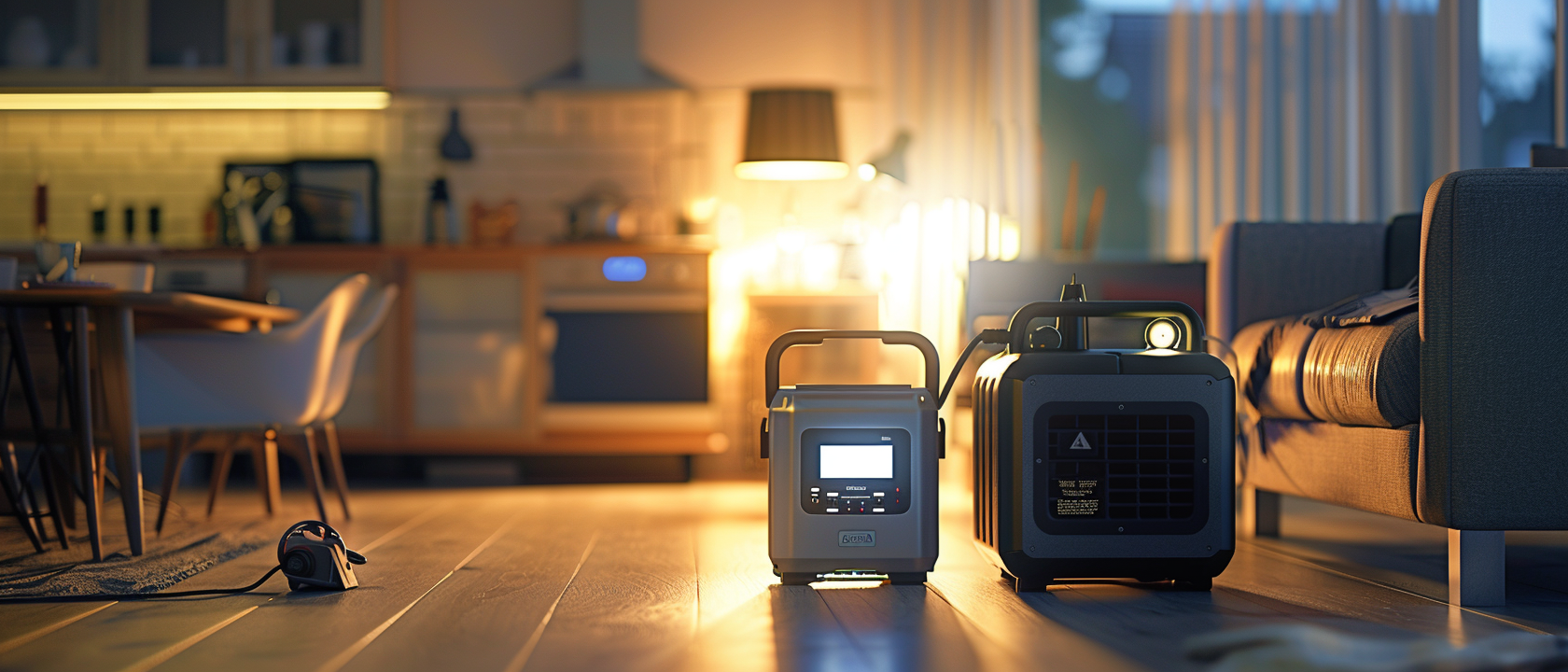
Generator vs Power Station: Which Is Right for Emergency Backup?
Compare portable generators and battery power stations for emergency preparedness. Learn which backup power solution fits your needs, budget, and situation.
Affiliate Disclosure: ZT1 Prep is reader-supported. When you buy through links on our site, we may earn an affiliate commission at no additional cost to you. This helps us keep creating practical preparedness content. Full disclosure.
Generator vs Power Station: Which Is Right for Emergency Backup?
Both portable generators and battery power stations can keep your essentials running during a power outage. But they’re fundamentally different tools with different strengths.
This comparison helps you choose the right backup power solution for your emergency preparedness needs.
Quick Comparison
| Factor | Generator | Power Station |
|---|---|---|
| Power output | 2000-10000W | 300-3000W |
| Runtime | Unlimited (with fuel) | 1-10 hours (depends on load) |
| Noise | 50-70 dB | Silent |
| Location | Outdoors only | Indoor use OK |
| Maintenance | Regular (oil, fuel) | Minimal |
| Startup time | 10-30 seconds | Instant |
| Fuel source | Gasoline/propane | Rechargeable battery |
| Price per watt | Lower | Higher |
| Weight | 40-100+ lbs | 10-50 lbs |
| CO risk | Yes (outdoor only!) | None |
The Fundamental Difference
Generators create electricity by burning fuel. They can run indefinitely (as long as you have fuel) and produce substantial power.
Power stations store electricity in batteries. They’re limited by battery capacity but are silent, safe indoors, and require no fuel.
Critical Safety Note
Generators must ALWAYS run outside, at least 20 feet from any window or door. Generator exhaust contains carbon monoxide, which kills people every winter storm. Power stations are safe indoors because they produce no exhaust.
When to Choose a Generator
Generators Win For:
Extended outages (24+ hours)
- Power stations will deplete; generators run as long as you have gas
- A 2000W generator runs 8+ hours on 1 gallon
- With 10 gallons stored, that’s 80+ hours of power
High-power loads
- Furnace blowers, refrigerators, sump pumps
- Multiple devices simultaneously
- Window AC units, power tools
Unlimited runtime needs
- Week-long outages
- Grid-down scenarios
- Situations where recharging isn’t possible
Cost-per-watt
- Generators cost $0.50-1.00 per watt
- Power stations cost $1.00-2.00+ per watt
Top Generators for Emergency Backup
Honda EU2200i Inverter Generator
The gold standard for portable inverter generators. Whisper-quiet, fuel-efficient, and legendary reliability.
Pros
- Legendary Honda reliability
- Very quiet (48-57 dB)
- Excellent fuel efficiency
Cons
- Premium price point
- May need two for large loads
ℹ️ EU2200i is current model - older EU2000i discontinued
Check Price on AmazonHonda EU2200i: The gold standard. Quiet, reliable, fuel-efficient. Powers a furnace + fridge + basic electronics. ~$1,000-1,200.
Champion 3400W Dual Fuel Inverter Generator
Excellent value dual fuel generator. Runs on gas or propane with electric start.
Pros
- Runs on gas or propane
- Electric start
- Great price-to-performance
Cons
- Heavier than smaller inverters
- Louder than Honda
ℹ️ Model 200986 is dual fuel version
Check Price on AmazonChampion 3400W Dual Fuel: More power for less money, runs on gas or propane. Great value at ~$500-600.
Generator Pros
- Higher continuous power output
- Unlimited runtime with fuel
- Lower cost per watt
- Can handle high-draw appliances
- Established, proven technology
Generator Cons
- Must run outside (CO danger)
- Loud (50-70 dB)
- Requires fuel storage
- Regular maintenance (oil, etc.)
- Can’t use in apartments/condos
- 10-30 second startup delay
When to Choose a Power Station
Power Stations Win For:
Short outages (2-12 hours)
- Most outages last under 12 hours
- A 1000Wh station handles lights, phones, laptops, router
Apartment/condo living
- No yard for a generator
- Power stations work inside
- No noise complaints
Essential electronics only
- Phones, tablets, CPAP, small medical devices
- Low-power LED lights
- Laptop, Wi-Fi router
Portability
- Lighter than generators
- No fuel to carry
- Works in the car
Solar recharging
- Can recharge via solar panels
- True independence from the grid
- Renewable during extended outages
Top Power Stations for Emergency Backup
Jackery Explorer 1000 Power Station
1002Wh portable power station. Reliable, well-built, powers essentials for hours.
Pros
- 1002Wh capacity
- 1000W continuous output
- Pure sine wave AC
Cons
- Heavy (22 lbs)
- Won't run high-draw heaters long
ℹ️ Explorer 1000 vs 1000 Plus (newer)
Check Price on AmazonJackery Explorer 1000: Solid, reliable, 1002Wh capacity. Powers essentials for 4-8 hours. ~$800-1,000.
EcoFlow DELTA 2 Power Station
1024Wh power station with fast charging and expandable capacity. LFP battery.
Pros
- 1024Wh capacity
- 0-80% charge in 50 minutes
- LFP battery (3000+ cycles)
Cons
- Premium price
- 27 lbs weight
ℹ️ DELTA 2 vs DELTA 2 Max (larger)
Check Price on AmazonEcoFlow DELTA 2: 1024Wh with fast charging and expandable capacity. Powers more demanding loads. ~$800-1,100.
Goal Zero Yeti 1000X Power Station
983Wh power station capable of running refrigerators and power tools. Expandable capacity.
Pros
- 983Wh capacity
- 1500W output (3000W surge)
- Runs full-size refrigerators
Cons
- Heavy (31.7 lbs)
- Premium price
ℹ️ Yeti 1000X vs older Yeti 1000 - X has better ports
Check Price on AmazonGoal Zero Yeti 1000X: Premium build quality, expandable, excellent for long-term reliability. ~$1,000-1,200.
Power Station Pros
- Silent operation
- Safe for indoor use
- No CO risk
- No fuel storage needed
- Minimal maintenance
- Instant power on demand
- Solar rechargeable
- Apartment-friendly
Power Station Cons
- Limited capacity
- Electric heaters drain them fast
- Higher cost per watt
- Must be recharged
- Battery degrades over time
- Can’t run high-draw appliances long
Real-World Runtime Comparison
Let’s compare running common emergency loads:
Furnace Blower (400W)
| Power Source | Runtime |
|---|---|
| 2000W Generator (1 gal gas) | 8+ hours |
| 1000Wh Power Station | 2 hours |
Refrigerator (150W average)
| Power Source | Runtime |
|---|---|
| 2000W Generator (1 gal gas) | 8+ hours |
| 1000Wh Power Station | 6 hours |
Phone Charging (20W)
| Power Source | Runtime |
|---|---|
| 2000W Generator (1 gal gas) | 8+ hours (overkill) |
| 1000Wh Power Station | 50 charges |
Space Heater (1500W)
| Power Source | Runtime |
|---|---|
| 2000W Generator (1 gal gas) | 6+ hours |
| 1000Wh Power Station | 40 minutes |
Pro Tip
Power stations are efficient for low-draw electronics but impractical for heating. If keeping warm is your priority, a generator powering your furnace (or a propane heater) is far more effective than running electric heaters on a power station.
The Hybrid Approach
Many prepared households have both:
Generator for:
- Extended outages
- Powering furnace
- Running sump pump
- Heavy loads
Power Station for:
- Immediate, silent power
- Short outages
- Medical devices at night
- Recharging via solar
- Apartment backup
This combination covers virtually any scenario.
Cost Comparison
Initial Investment
| Solution | Coverage | Cost |
|---|---|---|
| Quality generator (2000W) | High power, unlimited runtime | $500-1,200 |
| Quality power station (1000Wh) | Low power, limited runtime | $600-1,200 |
| Both | Complete coverage | $1,100-2,400 |
Ongoing Costs
| Solution | Ongoing Costs |
|---|---|
| Generator | Fuel (~$3-4/gallon), oil, maintenance |
| Power Station | Electricity to recharge (~$0.10-0.15 per full charge) |
Cost Per Emergency Hour
Assuming 8 hours of power:
| Solution | Cost Per Use |
|---|---|
| Generator | ~$5-10 (fuel + wear) |
| Power Station | ~$0.15 (electricity) + battery wear |
Decision Guide
Choose a GENERATOR if:
- You live in a house with outdoor space
- Outages commonly last 12+ hours
- You need to run furnace, fridge, sump pump
- Budget is a primary concern
- You’re comfortable with maintenance
- You have space for fuel storage
Choose a POWER STATION if:
- You live in an apartment or condo
- Outages are typically short (under 12 hours)
- You primarily need to power electronics
- You want silent, indoor-safe backup
- You plan to use solar for recharging
- Minimal maintenance is important
Choose BOTH if:
- You want complete preparedness
- Budget allows ~$1,500-2,500 total
- You face both short and extended outages
- Different family members have different needs
Frequently Asked Questions
Can a power station run a refrigerator?
Can a power station run a space heater?
How long do power stations last before needing replacement?
Can I run a generator in my garage with the door open?
Can I charge a power station while using it?
Related Guides:
ZT1 Prep Team
Practical preparedness for real life
Related Guides
Best Portable Power Stations for Emergency Preparedness
Top portable power stations and solar panels for power outages. Compare capacity, output, and solar charging for emergency backup power in 2025.
gearBest Portable Generators for Home Backup Power
Top portable generators for power outages and emergencies. Compare inverter vs conventional, wattage needs, and our picks for home backup in 2025.
gearBest Rechargeable Lanterns for Emergency Preparedness
Top rechargeable lanterns and lights for power outages and emergencies. USB charging, solar options, and long runtime picks for 2025.